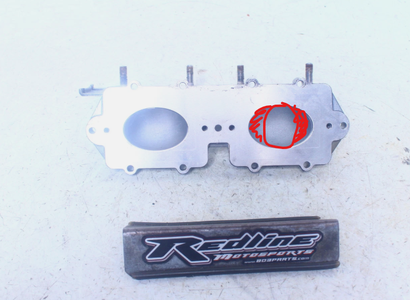
Stop blending your manifold. your killing your low end power and throttle response

waxhead

wannabe backflipper
Location
gold coast
A lot of riders assume all intake manifolds are basically the same — a simple piece that connects the carburetors to the reed cage.
That old way of thinking has stuck around since the 90s, and so has the habit of “blending the manifold into the reeds” to make it look smooth.


The reality is this:
modern two-stroke tuning is about wave control, not polishing.
And that’s exactly why our intake manifold was designed the way it is.


Built for Torque First — Without Choking the Top End


We designed the Wax Racing manifold with one core goal:


**Hit harder down low,​


keep the same top-end flow.**


The throat size is identical to the best high-RPM manifolds, so peak power isn’t restricted.
The difference is in the shaping — it’s built to manage the pressure wave properly, not just provide a straight passage.


This is why you feel:


  • snappier throttle
  • stronger holeshot
  • better pull before the pipe
  • cleaner transition into mid-range

All while keeping the exact same top-end RPM you’d expect.


Not Just a Connector — A Functional Part of the Power System


Two-stroke engines don’t run on “steady airflow.”
They run on rapidly changing pressure waves.


A manifold that’s just a blended tunnel works fine for forward airflow…
but it also makes it easy for reverse pulses to travel backward up the intake.


That’s how you lose:


  • consistent jetting
  • bottom-end torque
  • clean throttle response

The Wax Racing manifold is shaped to do the opposite:


  • direct forward pulses cleanly into the reeds
  • resist reverse pulses trying to travel out of them
  • keep a high-speed air column packed at the reed face
  • stabilise the carb signal

It acts like a proper waveguide, not just plumbing.


Modern Tuning Knowledge — Not Outdated Blending


The old ideas of “blend everything” and “open it up so it flows more” ignore how two-stroke intake waves actually behave.


Using modern understanding of:


  • pressure-wave direction
  • reversion flow
  • reed timing
  • signal stability at the carb
  • air-column behaviour during reed closure

…we shaped the manifold to work with the engine, not against it.


There’s real testing and real thought behind this design — not just smoothing everything shiny and hoping it works.


What You’ll Feel on the Water


You’ll notice:


  • harder hit off the bottom
  • better drive through corners
    • cleaner throttle when loading the pump
    • stronger early acceleration
    • no drop in top-end pull

  • Your jetting becomes more predictable too, because the intake pulses feeding the carb are more stable.
 
I hope not, one of my favorite things about the Wet-Jet manifold is that it uses 1 gasket not 2! They were able to make it 1 piece 30 years ago, why would that not be possible now? I guess you are wanting it to be billet and not cast?
 

waxhead

wannabe backflipper
Location
gold coast
I hope not, one of my favorite things about the Wet-Jet manifold is that it uses 1 gasket not 2! They were able to make it 1 piece 30 years ago, why would that not be possible now? I guess you are wanting it to be billet and not cast?
the problem being now to make it cast it very expensive to make the mould and lets be honest im not going to sell that many of them. When i make a part it has to also cover the cost. On the exhausts we made a lot but i dont know that the wetjet style will be a big seller
 

waxhead

wannabe backflipper
Location
gold coast
Ahh ok yeah thats a cool idea, I would be interested to see the results. The issue i would see is the long term effect of the fuel as well as radiant heat when your sitting there after a run. That being said its always good to try stuff. What size carbs are you using to work this out on
 
I'm mostly just....thinking it would be cool to try but not actually doing anything lol.

"Some day"

Probably 44's or 46's on a stock manifold because the ski that I run 38's is the one that I prioritize not-screwing around more than I prioritize performance (otherwise it would have bigger carbs).

A guy could maybe 3d print a "plug" and use it to fill in the rest of the void with jb weld.
 
Location
dfw
Reducing the area between the reed and butterfly will increase the pressure drop at the Venturi. It should make jetting a tiny bit richer than it was. I have filled an open 750 single carb manifold and cut smaller runners in it. The carb ran noticeably richer. After more experimenting I forever abandoned single carbs on 750s.
 

Jcary85

Site Supporter
Vendor Account
Location
Glenmoore pa
I'm mostly just....thinking it would be cool to try but not actually doing anything lol.

"Some day"

Probably 44's or 46's on a stock manifold because the ski that I run 38's is the one that I prioritize not-screwing around more than I prioritize performance (otherwise it would have bigger carbs).

A guy could maybe 3d print a "plug" and use it to fill in the rest of the void with jb weld.
Let’s try some of these ideas once I get this Dyno going! I’ve been watching wax talk about manifold design and a lot of wheels have been turning on stuff to try. Dyno is the only way you are going to measure what actually makes a difference
 
Location
dfw
If you play the dyno game you’ll quickly learn they are really good at showing big HP numbers at high rpm. Then you will learn that high ports and dry pipes are the only thing that make big hp numbers. Giant carbs can make the pipe hit harder. Our peak rpm is always over the top of the torque bubble. Big carbs can make that area worse because they tend to go richer than a smaller one that is already at peak flow.
 
If I'm not mistaken Jordan is a guy with an electronics background that bought himself a mill taught himself how to use it started building motors and now has a couple of pro freestyle championships with those motors...in...two years? Something like that.

I think getting useful info from a dyno for freestyle is going to be tricky but....I'm confident that he won't be an idiot about how he runs the dyno.
 

waxhead

wannabe backflipper
Location
gold coast
Reducing the area between the reed and butterfly will increase the pressure drop at the Venturi. It should make jetting a tiny bit richer than it was. I have filled an open 750 single carb manifold and cut smaller runners in it. The carb ran noticeably richer. After more experimenting I forever abandoned single carbs on 750s.

I’m not a single-carb guy myself. And regarding the dyno — you’re right, and we’re actually in agreement. Big horsepower? Sure, no problem. Throw 200° exhaust and 132° transfers at it with a dry pipe and you’ll make numbers all day.

But it won’t leave the dock with any urgency unless you’re basically running a saw blade for an impeller. People seem to forget there used to be a company building stroker motors with spacer plates under the cylinders, and they required you to run excessive pump clearance just to get the thing on the pipe.

Yeah, they made great power up top… but we all know the trade-off.
 

Jcary85

Site Supporter
Vendor Account
Location
Glenmoore pa
Ya guys we aren't looking for peak numbers on the dyno but power under the curve will be interesting. Does a certain intake design make more torque down low? does it move the power band? etc etc. Lots of data to collect on a modern dyno and peak power isn't really relevant for our (well my) application.
 

Jcary85

Site Supporter
Vendor Account
Location
Glenmoore pa
and for the record I'm no expert. the dyno thing could be a waste of time. There are plenty of people who have tried the dyno thing. I think most people were using older DAQs though with lower resolution which might have hurt the ability to actually measure anything properly.
 

waxhead

wannabe backflipper
Location
gold coast
and for the record I'm no expert. the dyno thing could be a waste of time. There are plenty of people who have tried the dyno thing. I think most people were using older DAQs though with lower resolution which might have hurt the ability to actually measure anything properly.
What your looking for in a surf free ride and all out fun ski is throttle resposne and how hard it hits the powerband. This is what can be measured on the face mile dyno. I have a data logger which can measure rate of acleration on the ski but thats more for dialing in pump load and ride plates. But i have seen enough people change to our manifold and see the smile on their face
 
Location
dfw
Do initial testing without the pipe, just the manifold. That will give you a smooth torque curve so any intake changes will be easier to see. The carb tune will need to be leaner than what is required for a pipe.
 
Top Bottom